Baby plagiocephaly in Barcelona
Gentle osteopathy and treatment
What is plagiocephaly in babies?
Plagiocephaly is a common deformation of a baby’s skull that causes a flattening of the head. Although it is usually benign, it is important to detect it early to prevent it from worsening.
. This anomaly can be worrying for parents, however, with adequate information and early action, the effects can be mitigated or even reversed.
It is usually associated with constant sleeping positions or limitations of movement.
It is essential to educate parents about the importance of early detection and repositioning techniques, which can be simple but crucial for healthy skull development.
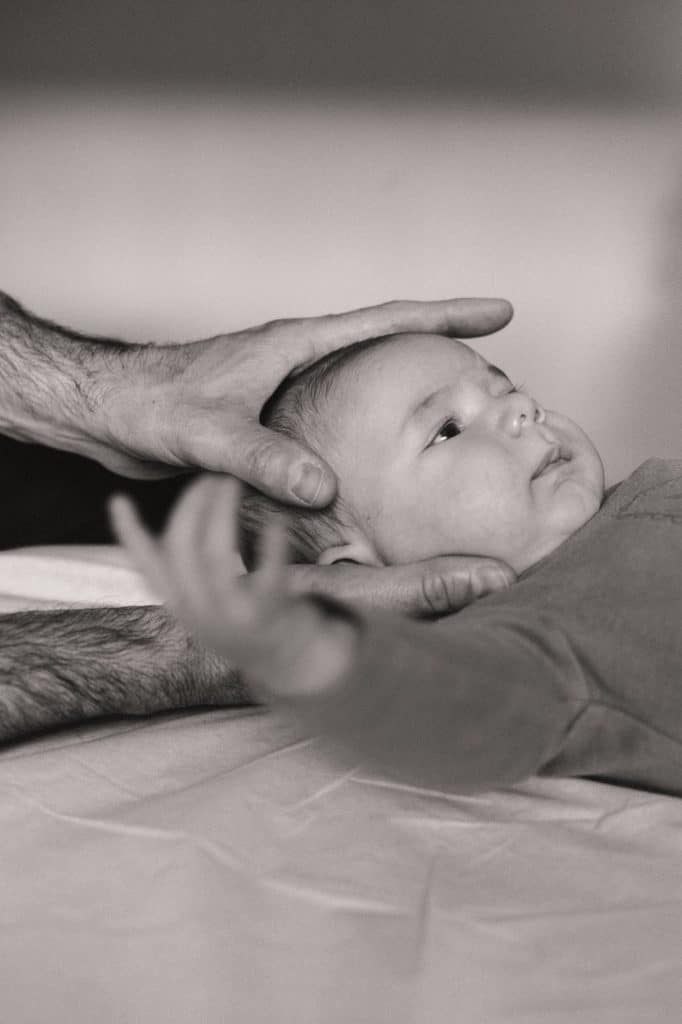
The paediatric osteopathy can help release tension in the baby's skull and neck, promoting more balanced development.

Have you noticed that your baby’s head is flattened or that they always turn their head to the same side?
It is recommended to carry out an assessment after birth and to provide follow-up if any asymmetry appears.
Osteopathy can help
to improve neck mobility and release tensions that promote plagiocephaly
Preventive actions
If you notice your baby always turns their head to the same side, consult your doctor as soon as possible to prevent plagiocephaly from worsening.
Why does plagiocephaly occur?
Understanding mild plagiocephaly and its causes
Plagiocephaly can develop for a number of reasons, many of which are related to positional and environmental factors. The most common causes include:


Constant pressure
Flattening can occur when the baby spends too much time in a position that puts pressure on a specific part of the skull. This is particularly common since it is recommended that babies sleep on their backs to reduce the risk of sudden infant death syndrome (SIDS).
Tortícongenital colis
Some babies prefer to turn their head to one side more than the other, either for comfort or due to conditions where there is tightness or shortening of the neck muscles.
The importance of early diagnosis of plagiocephaly
The diagnosisóEarly diagnosis of plagiocephaly is essential for effective treatment.
Detecting asymmetry early
Early recognition of signs of plagiocephaly allows the implementation of preventive techniques to avoid its progression.
Prevent further worsening
Early intervention ensures better chances for the baby's head to return to a more natural and symmetrical shape.
Reduce the need for a helmet
Early diagnosis can reduce the need for more invasive treatments, such as the prolonged use of corrective helmets.
The aim is to promote a balanced and harmonious development.
Preventing aggravation of the condition contributes to the baby's overall comfort and health.
A complicated delivery or the use of instruments may influence the shape of the skull at birth.
However, it is important to distinguish positional plagiocephaly from craniosynostosis, a medical condition in which the skull sutures fuse prematurely, restricting skull growth and requiring surgical intervention.
Factors to consider for early diagnosis
- Observe the shape of the baby's head regularly.
- Detect a side preference
- Encourage tummy time
- Alternate positions
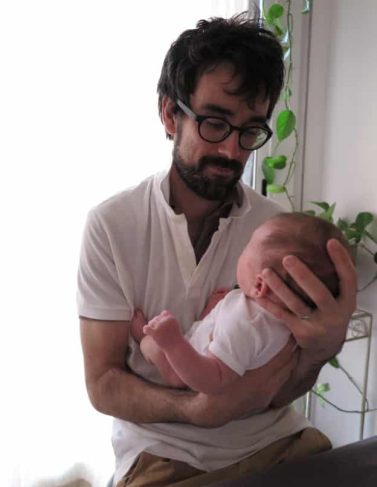
Some signs include:
- Unilateral flattening: One side of the back of the head appears flatter compared to the other side.
- Ear asymmetry: one ear may be positioned further forward than the other due to flattening.
- Bulging forehead: on the same side as the flattening, the forehead may appear to protrude more.
- Lump at the back of the head: on the side opposite the flattening, a compensatory lump may develop.
It is essential to rely not only on visual observation but also on touch; feeling the back of the baby's head can help to detect irregularities.
If in doubt, get an assessment as soon as possible.
Early care makes all the difference

Moderate plagiocephaly
In moderate plagiocephaly, there is obvious asymmetry with minimal forehead prominence or facial asymmetry.
In these situations, care involves adapting the baby’s positioning to relieve pressure on the flattened area.
Motor development therapies, stretching and mobilisation can also be used.
Severe plagiocephaly
For severe plagiocephaly, significant flattening of the occiput is observed, protrusion of the forehead on the affected side, and the ears may be clearly misaligned.
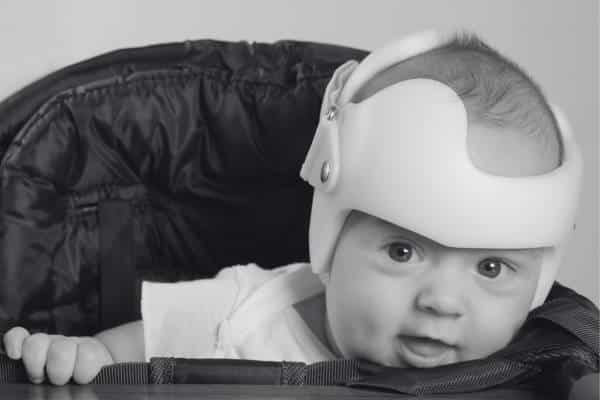
In these situations, the use of an orthotic helmet may be considered, along with appropriate specialised follow-up.
It is important to mention that the treatment should be stepped, starting with the least invasive measures such as repositioning and osteopathy.ía and considering options such as the orthopaedic helmets depending on the severity and the patient's response to initial treatment.
Early care, particularly in the first months, helps greatly limit the progression to more pronounced forms of plagiocephaly.

How to avoid plagiocephaly: tips and practices
Treatment of plagiocephaly in infants generally focuses on corrective and preventive practices:
Osteopathy: postnatal assessment and follow-up in the early months
Parent Education: How to Prevent and Correct Posture
Positioning: alternating the head and encouraging tummy time
.Physiotherapy: improving cervical mobility
Orthopaedic helmet: in moderate to severe cases
Each of these methods aims to take advantage of the natural ability of the baby's skull to reshape itself, promoting a balanced and harmonious development.
.Osteopathy can help to improve mobility and reduce the stresses that lead to deformity. it has a preventive approach, which can treat the source of the problem before the deformity develops, and it can also help to reduce the stresses that lead to deformity.ómanifests
- Manual techniques: gentle and precise movements to release tension and promote balance in the cranial structure.
- Holistic approach: osteopathy considers the body as a unit and looks for the origin of the asymmetry in order to treat it.
Osteopathy may be a viable option for treating plagiocephaly, and it is important to consult with qualified professionals.
Questions about plagiocephaly
The correction of plagiocephaly involves various strategies depending on the severity and age of the child.
In mild cases, after the osteopathic session to correct the baby's posture and release tensions, we explain to the parents how repositioning therapy is the first step, encouraging tummy time while the baby is awake and supervised.
This practice strengthens the neck and shoulder muscles and reduces pressure on the flattened part of the head.
It is essential to change the position of the baby's head while sleeping and during breastfeeding time, alternating arms for feeding and putting the baby to bed with the head turned to the side opposite the flattening.
Plagiocephaly, commonly known as flat head syndrome, can vary in severity but generally does not affect a baby's brain development. However, if left untreated, it can lead to significant cosmetic problems and, in rare cases, may be associated with developmental delays or neurological complications due to prolonged pressure on one part of the skull.
In mild cases, early interventions such as repositioning therapy and strengthening of the neck muscles are usually sufficient to correct the shape of the skull.
Failure to treat plagiocephaly can lead to permanent facial or cranial asymmetries that, in some cases, may require corrective surgery in adulthood. In addition, cranial deformity can influence a child's self-esteem and social interaction as he or she grows older. For these reasons, it is essential to consult a paediatrician if plagiocephaly is suspected to assess the need for treatment and follow-up.
To correct plagiocephaly at home, parents can adopt several strategies to help improve the shape of the baby's head and prevent further flattening:
- Tummy time: Make sure your baby spends enough time on his tummy while awake and under supervision. This strengthens the neck muscles and promotes healthy cranial development.
- Change sleeping position: Vary the position of your baby's head when sleeping, alternating the side to which the head is tilted to avoid continuous pressure in one spot.
- Minimise time in car seats and baby carriers: Try to limit the time your baby spends in devices that restrict movement, such as car seats, swings and baby carriers, as these can contribute to flattening.
- Exercises and massage: If your baby has torticollis (difficulty turning the head to one side), gentle massage and stretching exercises recommended by a physiotherapist can help improve mobility.
- Visual and physical stimulation : use toys and activities that encourage your baby to turn his head and move, thus distributing pressure more evenly over the skull.
The main difference between plagiocephaly and brachycephaly lies in the area of the skull that is affected and the type of flattening.
The plagiocephaly is characterised by lateral flattening, usually on one side of the skull (occipital), and is often associated with congenital torticollis, which may cause one ear to appear more forward than the other and the forehead to bulge on the affected side.
The brachycephalyBrachycephaly, on the other hand, is manifested by a symmetrical flattening of the entire back of the skull, which may cause the baby's head to appear wider than normal and the ears to protrude. Brachycephaly is commonly seen in babies who spend a lot of time sleeping on their backs.
Sleeping with the head on its side can lead to asymmetrical flattening of the skull, known as positional plagiocephaly.
To prevent this, it is important to alternate the direction the baby's head turns when sleeping and to encourage supervised tummy time during the day to strengthen the neck muscles and promote balanced cranial development. It is also recommended to avoid prolonged use of devices that restrict the baby's movement, such as car seats.
To avoid plagiocephaly, it is crucial that babies sleep on their backs, but varying the position of their head to avoid constant pressure on the same spot.
It is advisable to change the position of the baby's head from one side to the other on alternate nights and to make sure that the baby has enough tummy time during the day, always under supervision.
This not only helps to prevent plagiocephaly, but also contributes to the strengthening of the neck muscles.
Limiting the time a baby spends in baby carriers, car seats and swings can reduce the constant pressure on one part of the head.
The key is balance and ensuring that the baby is not in one position for prolonged periods of time.
These answers synthesise the recommendations and findings of the sources consulted and provide you with general guidance on how to manage and prevent plagiocephaly.
For further information, I encourage you to visit the pages of the University of Navarra Clinic y EnFamilia of the Spanish Association of Paediatrics.
In addition, for specific cases or particular doubts, it is always advisable to consult directly with a paediatrician or child health specialist.
Plagiocephaly is assessed and treated by a multidisciplinary team of health professionals. The first point of contact is usually the paediatrician, who may make an initial assessment and, depending on the severity of the deformity, refer parents to additional specialists.
In more complex or severe cases, intervention by child neurologists or craniofacial surgeons may be necessary.
In addition, physiotherapists can play a crucial role in the treatment of plagiocephaly, especially when associated with torticollis, by offering exercises and therapies to improve mobility and symmetry.
For more details and specific recommendations, it is recommended that you consult the pages of Premium Rehabilitation Madrid y PlagiocephalyThe website provides a wide range of information on the diagnosis, differentiation and treatment of cranial deformities in infants.
To avoid flat head syndrome, officially known as positional plagiocephaly, it is essential to take preventive measures from birth.
The key is to minimise sustained pressure on one part of the skull, which can deform the skull due to the softness and malleability of the cranial bones in the first months of life.
Here are some recommendations based on practices suggested by experts:
- Alternate head position: When the baby is lying on his or her back, alternate the direction in which the head turns each night. This helps prevent constant pressure on one side of the skull.
Upside-down time: promotes tummy time during times when baby is awake and under supervision. This time is not only vital for baby's motor development but also reduces pressure on the back of the baby's head.
Avoid excessive use of restraints: try to limit the time your baby spends in car seats, bouncers, swings and baby carriers, as these can contribute to flattening of the skull by restricting your baby's movement and putting constant pressure on one area.
Promote active movement: As your baby grows, encourage physical activity and play that promotes movement, which is not only beneficial for physical development but also helps prevent constant pressure on one part of the head.
Consultation with health professionals: If in doubt or if you notice signs of flattening in your baby's head, it is important to consult your paediatrician or a specialist for personalised advice and, if necessary, a treatment plan.
For more information and practical advice, you can visit authoritative sites such as the American Academy of Pediatrics y HealthyChildren.
If plagiocephaly goes untreated, there may be long-term consequences, although these vary depending on the severity and nature of the head deformity.
In many cases, untreated positional plagiocephaly can result in permanent cranial asymmetries which, although generally not affecting brain development, can have aesthetic and psychological implications for the child as he or she grows older.
In rare and more severe cases, where plagiocephaly may be associated with restricted brain growth or underlying conditions such as craniosynostosis, failure to treat the condition may have more serious implications for the child's neurological and functional development.
Early diagnosis and treatment is essential to improve the head shape and minimise possible consequences. Treatment may include repositioning therapy, physiotherapy, and in some cases, the use of an orthopaedic helmet to correct the deformity.
For specific advice and diagnosis, it is essential to consult a paediatrician or child health specialist. Sites such as KidsHealth y Mayo Clinic can provide additional information and guidance on this condition and its management.
The decision to use a helmet to treat plagiocephaly is considered when initial measures, such as repositioning therapy and exercises, are not effective.
Generally, this treatment is recommended in cases of moderate to severe deformity, and is most effective if started between 4 and 6 months of age, as the skull bones are still very flexible and malleable.
Helmet treatment can vary in duration, but constant follow-up by a specialist is crucial to ensure the best possible outcome.
Diagnosis of plagiocephaly is usually made by visual observation and palpation of the skull to detect any asymmetry or flattening.
In some cases, tools such as a craniometer can be used for more precise measurements.
In addition, other factors such as the presence of torticollis, which may contribute to the condition, are assessed. Early diagnosis is important to initiate appropriate treatment as early as possible to avoid long-term complications.
For more details and specific advice, I recommend that you visit the pages of Quirónsalud y JL PHYSIOSwhere you will find valuable information on these issues.