Plagiocephaly in babies in Barcelona
What is plagiocephaly in babies?
It's when a baby's head flattens on one side. Parents almost always notice it when looking from above, when the baby is lying down: one ear is further forward than the other, the forehead is asymmetrical, and the back of the head is flat on one side.
A newborn's skull is soft and malleable for the first few months. This allows it to pass through the birth canal and for the brain to grow rapidly, but it also means that a maintained posture leaves its mark. If the baby always rests on the same side, that area flattens.
There is usually something behind it that prevents them from turning well: tension in the neck, congenital torticollis, a posture they already had from the pregnancy. The baby doesn't choose that side; it's just that the other side is difficult for them.
The paediatric osteopathy can help release tension in the baby's skull and neck, promoting more balanced development.

Why does plagiocephaly occur?
Understanding mild plagiocephaly and its causes
Almost always because the baby always rests their head on the same side. The useful question isn't that, but rather: why do they always rest it on that side.
A neck strain. This is the cause we see most often. The baby turns well to one side, but struggles to turn to the other, so they always end up in the same position. Sometimes it's congenital torticollis, sometimes it's a more subtle tension that's only noticeable when you look closely.
What was the birth like?. A prolonged expulsion, the use of forceps or a ventouse, a complicated presentation. The head has undergone pressure and may have a less mobile area.
The posture of the last few weeks of pregnancy. A baby who has been deeply engaged for a long time, with little fluid, and in a twin pregnancy. They arrive in the world with a pre-established positional preference.
Face up time. Sleeping on your back significantly reduces the risk of sudden death and should be maintained, without question. But if you add hours in a hammock, stroller, and car seat, the head spends the day resting. The counterbalance is time spent on your front, awake and in front of you.
Prematurity. The skull is even softer and the baby spends more time lying down.
None of these causes imply anything has been done wrong. The majority of babies with a flattened head have had perfectly normal care.


How to detect it early
Plagiocephaly is better viewed from above than from the front. With the baby lying down, get down to the level of their head and look from above: a flatter area at the back of the head, one ear further forward than the other, sometimes the forehead slightly more prominent on the same side. From the front, it's barely noticeable, which is why many parents take weeks to spot it.
The other sign, and the one that matters most, is head preference. Notice where the head ends up when the baby is calm in the cot or on the changing mat. If they always turn to the same side, or if they protest when you turn their head the other way and immediately turn it back, then there's something to look into.
A simple trick: switch him to the other side in the changing table, or change his orientation in the cot, so he has to turn to the side he uses less to follow you with his eyes. If he still doesn't turn, it's not a matter of habit.
And tummy time awake, from the first few weeks. For short periods, many times a day, with you in front of him. It strengthens his neck and reduces the hours he spends resting his head.
It's best to have it checked before four months, while the skull can still be easily repositioned.
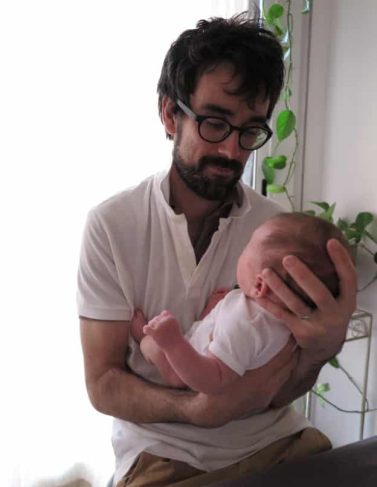
Some signs include:
- Unilateral flattening: One side of the back of the head appears flatter compared to the other side.
- Ear asymmetry: one ear may be positioned further forward than the other due to flattening.
- Bulging forehead: on the same side as the flattening, the forehead may appear to protrude more.
- Lump at the back of the head: on the side opposite the flattening, a compensatory lump may develop.
It is essential to rely not only on visual observation but also on touch; feeling the back of the baby's head can help to detect irregularities.
If in doubt, get an assessment as soon as possible.
Early care makes all the difference

Moderate plagiocephaly
In moderate plagiocephaly, there is obvious asymmetry with minimal forehead prominence or facial asymmetry.
In these situations, care involves adapting the baby’s positioning to relieve pressure on the flattened area.
Motor development therapies, stretching and mobilisation can also be used.
Severe plagiocephaly
For severe plagiocephaly, significant flattening of the occiput is observed, protrusion of the forehead on the affected side, and the ears may be clearly misaligned.
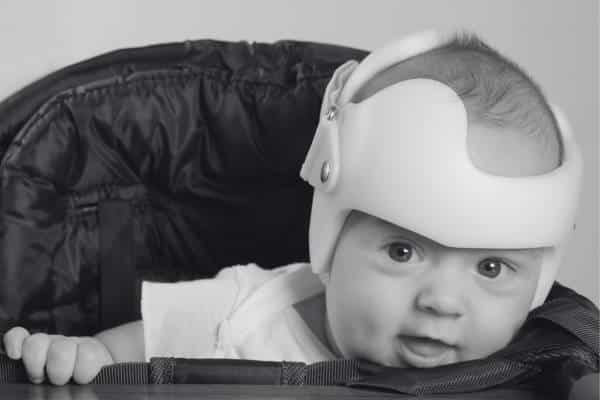
In these situations, the use of an orthotic helmet may be considered, along with appropriate specialised follow-up.
It is important to mention that the treatment should be stepped, starting with the least invasive measures such as repositioning and osteopathy.ía and considering options such as the orthopaedic helmets depending on the severity and the patient's response to initial treatment.
Early care, particularly in the first months, helps greatly limit the progression to more pronounced forms of plagiocephaly.

How to avoid plagiocephaly: tips and practices
Treatment of plagiocephaly in infants generally focuses on corrective and preventive practices:
Osteopathy: postnatal assessment and follow-up in the early months
Parent Education: How to Prevent and Correct Posture
Positioning: alternating the head and encouraging tummy time
.Physiotherapy: improving cervical mobility
Orthopaedic helmet: in moderate to severe cases
Each of these methods aims to take advantage of the natural ability of the baby's skull to reshape itself, promoting a balanced and harmonious development.
.Osteopathy can help to improve mobility and reduce the stresses that lead to deformity. it has a preventive approach, which can treat the source of the problem before the deformity develops, and it can also help to reduce the stresses that lead to deformity.ómanifests
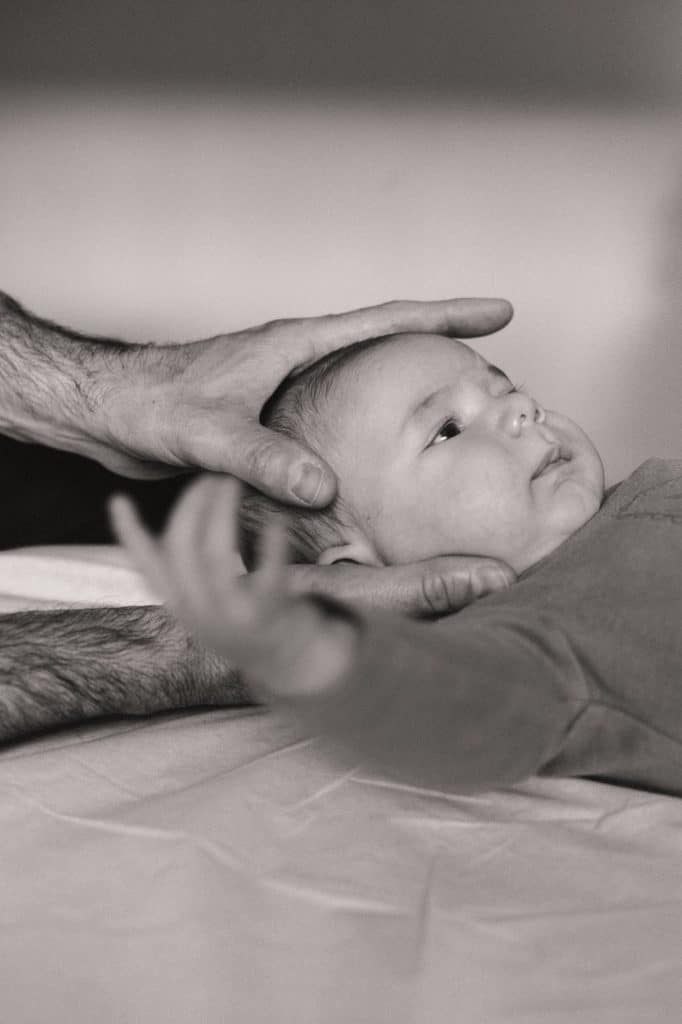
- Manual techniques: gentle and precise movements to release tension and promote balance in the cranial structure.
- Holistic approach: osteopathy considers the body as a unit and looks for the origin of the asymmetry in order to treat it.
Osteopathy may be a viable option for treating plagiocephaly, and it is important to consult with qualified professionals.
Questions about plagiocephaly
Positional plagiocephaly is a flattening of an area of a baby's head, usually at the back or on one side. It typically develops when a baby repeatedly rests their head in the same position during their first few months of life.
It can appear when the baby consistently turns their head to the same side, when they have less comfort moving freely, or when they spend a lot of time resting on the same area. Sometimes, the position during pregnancy or birth also plays a role.
Osteopathy can help by observing the baby holistically: their mobility, their rotation preference, their tensions, and their body organisation. In our practice, we do not seek to “mould” the head, but rather to support the baby with a gentle and respectful approach to encourage better mobility and adaptation.
We value how the baby turns its head, how its neck moves, how its body is organised, and if there are any tensions that might always favour the same position. We also take into account the baby's daily routine, its postures, and the way it is held, fed, or placed.
No. In our practice, we work with gentle, tissue-based, and biodynamic osteopathy, without abrupt manipulations. The aim is to respect the baby's rhythm and support their natural capacity for reorganisation.
It can be helpful to vary positions when the baby is awake, to encourage the baby to look both ways, to encourage supervised tummy time and to alternate sides when holding or feeding. These are small changes that can go a long way in everyday life.
It is advisable to consult when you notice a clear flattening of the head, a marked preference for one side, difficulty turning comfortably, or when the asymmetry does not improve over time. Early assessment is usually more helpful than waiting too long.
No. Osteopathy does not replace paediatric assessment. In our practice, we work in a complementary way, with a holistic and respectful approach, and we refer when more specific medical assessment is required.